
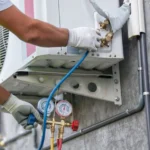
Your AC just went down. The service you called is offering two prices, one to repair and one to replace. Here’s how to know which one is the right call — without the upsell pressure or the scare tactics.
Replace or Repair – The Decision Moment
The words don’t sound good. The compressor is shot, or the system has a refrigerant leak, or the unit just can’t keep up with the first 90-degree week of the year. Do you want to repair or replace? Neither option sounds wallet friendly at this point, but making a decision can’t be put off.
This is the moment when most homeowners feel cornered. The system is dead, the house is hot, and you want to make the right call, but you don’t know what “right” looks like.
This guide gives you a frame of reference, the knowledge you need before you commit to either choice. First, let’s take a look from a 30,000 foot view.
How Long Should an AC Last in Alabama?
Most central air conditioning systems last 10 to 15 years in Alabama’s hot, humid climate, though well-maintained units can reach 12–16+ years. The national average is closer to 15 to 20 years, but our longer cooling season, high humidity, and sustained heat work equipment much harder than in milder climates.
Birmingham summers run long. The cooling season starts in April or May and stretches into October, with months of sustained 90-degree heat and high humidity layered on top. Your AC isn’t just cooling air — it’s removing moisture, fighting humidity, and running through more annual hours than the same equipment would in Denver or Boston.
That additional load shortens equipment life. A system that might reach 18 years in a milder climate will more often hit 12 to 14 here before major components start to fail. If your unit is past 12, age is on the table as a real factor in the decision. If it’s under 8, age is not the issue.
What Refrigerant Does Your System Use?
This is a question most homeowners skip, and it’s an important one. The refrigerant inside your AC has a direct impact on whether repair makes any sense at all.
R-22 systems. R-22 (sometimes called Freon) was phased out for new equipment in 2010, and U.S. production ended in 2020. Existing R-22 systems can still be serviced, but the refrigerant itself has become scarce and expensive. A leak in an R-22 system today often costs more to recharge than the system is worth. If your AC was installed before 2010 and uses R-22, a refrigerant-related repair is almost always pointing toward replacement.
R-410A systems. R-410A has been the standard for residential AC since the early 2000s. Starting January 1, 2025, manufacturers must transition new residential systems to lower-GWP refrigerants, primarily R-454B and R-32. Existing R-410A systems can still be serviced, and refrigerant supplies will be available for years, though prices are expected to rise as production tightens.
New systems. Equipment manufactured after January 2025 uses lower-GWP refrigerants, mainly R-454B and R-32. These A2L refrigerants (mildly flammable) run more efficiently, have a much smaller environmental impact, and require new safety features in the equipment. They are not interchangeable with older refrigerants.
If your technician quotes a major refrigerant repair on an R-22 system, ask what the same money looks like applied to a new unit. The math usually answers itself.
What’s the Repair-Cost Math?
Two simple frameworks help most homeowners get to the right answer.
The age-times-cost rule. Multiply the age of your AC by the cost of the proposed repair. If the result is more than the cost of a new system, replacement is usually the better investment. The same dollar repair feels very different on a 4-year-old unit than on a 14-year-old one. The older unit’s age multiplier produces a number that often crosses the threshold all by itself.
The $5,000 rule. A useful starting point, not a hard line. If the proposed repair cost multiplied by the system’s age exceeds $5,000, replacement is worth a serious look. Below that, repair is typically the smarter call.
Neither of these is gospel. They are starting points that help frame the conversation. The real number to focus on is cost per remaining year of equipment life. A repair that buys eight more years is different from the same repair that buys two.
A few situations push the math faster toward replacement:
- The same component has failed twice in the same season
- The system has a major refrigerant leak in an R-22 unit
- The repair is on the compressor, the heat exchanger, or another major component
- The system has needed steady smaller repairs for several years already
When two or more of those apply, the equation can tilt in favor of replacement.
Are You Paying for Old-System Inefficiency?
Even if your aging AC still cools the house, it may be costing you significantly more to do it. SEER and SEER2 ratings measure how efficiently a system converts electricity into cooling. The higher the number, the less you pay to run it.
A typical AC from 2005 carries a SEER rating around 10. A modern system meeting current federal minimums for the Southeast carries a SEER2 rating of 14.3 or higher, and most quality units run 15 to 18 SEER2. That difference shows up directly on your power bill.
In Alabama’s long cooling season, the gap matters more than it would somewhere with a short summer. A system that runs six or seven months a year produces a much faster payback on efficiency upgrades than one that runs for three. Many homeowners replacing a 12-to-15-year-old unit see noticeable monthly savings the first summer the new system runs.
This doesn’t mean efficiency alone justifies replacing a system. It means that if you’re already weighing repair against replacement, the operating-cost difference belongs in the calculation. An older system isn’t just costing you the repair quote; it’s also locking in years of higher energy bills.
Warning Signs That Point Toward Replacement
Sometimes there are signs you just can’t ignore. If several of these apply to your system, replacement is likely the better long-term call.
- Repeat repairs in the same season. A capacitor in May, a fan motor in July. The pattern usually continues.
- Uneven cooling room to room. Some rooms stay comfortable, others don’t. The system’s capacity is no longer matching the load.
- Rising bills despite tune-ups. Efficiency loss as components age, refrigerant levels dip, or ductwork degrades.
- Visible corrosion on the outdoor unit. Coil damage from years of weather exposure shortens remaining life.
- Persistent humidity issues. The system cools but the house feels clammy. Often a sign that the unit can no longer manage moisture load.
- A failing compressor or heat exchanger. These are the major-component repairs and may equal a significant portion of the cost of a new system.
None of these alone is automatic. Two or three together usually settle the question.
What an Honest Assessment Looks Like
Here’s how Integrity Airworks approaches the repair-or-replace question.
We start with a full system inspection and not just a quick look at the failed component. Age, refrigerant type, condition of the coils, condition of the ductwork, recent repair history, and energy bills all factor in. We walk you through what we find and explain how the trade-offs apply to your specific situation.
We also tell you when HVAC repair is the right call. If your system is six years old, uses R-410A, and has a single component failure, replacement may not be the answer and a simple repair will do you well. We don’t push systems on homeowners who don’t need them. The brand is built on standing behind our recommendations, and that goes both directions.
When a new HVAC installation (replacement) is the better call, we explain why in plain terms. We size the new system to your home, present options at different price and efficiency levels, and let you decide. No pressure, no urgency, no upsell.
That’s the assessment you’re entitled to from any HVAC company. If you’re getting something different, get a second opinion. At Integrity Air, we’re always ready to serve our neighbors.
Frequently Asked Questions
How Old Is Too Old for an AC in Alabama?
Ten to twelve years is the point where age becomes a real factor. Most central air conditioning systems last 10 to 15 years in Alabama’s hot, humid climate, though well-maintained units can reach 12–16+ years. The national average is closer to 15 to 20 years, but our longer cooling season, high humidity, and sustained heat work equipment much harder than in milder climates.
Is It Worth Repairing an R-22 System?
Usually not — especially when the repair involves refrigerant. R-22 production ended in the U.S. in 2020, and what remains is increasingly expensive. A refrigerant leak in an R-22 system often costs more to recharge than a new energy-efficient system would deliver in long-term value. Smaller, non-refrigerant repairs can still make sense if the rest of the system is sound.
Can I Just Replace the Outdoor Unit and Keep the Indoor One?
Sometimes, but it’s rarely the best choice. The outdoor condenser and indoor evaporator coil are designed to work together at matched specifications. A mismatched pair runs less efficiently and may not be covered under warranty. With the 2025 refrigerant transition, full system replacement is almost always recommended when refrigerant types differ or units are significantly different in age.
What SEER2 Rating Should I Look For?
Federal minimums for the Southeast region (which includes Alabama) currently sit at 14.3 SEER2 for new central AC equipment. Most quality systems sold today run 15 to 18 SEER2. Higher ratings cost more upfront but pay back faster in our long cooling season. We help homeowners weigh the options based on how long they plan to be in the home.
Schedule a Straight Assessment
If your AC has failed or you’re seeing warning signs and you want a calm, no-pressure look at your options, we’re happy to take the call. We diagnose the system, walk you through the math, and explain what we’d recommend if it were our home.
Integrity Airworks is a NADCA-certified, veteran-owned HVAC and air duct cleaning company based in Hoover, Alabama. We serve homes across the Birmingham metro, including Hoover, Vestavia Hills, Homewood, Pelham, and surrounding communities in Jefferson and Shelby counties.
Ready to get some help or advice with your aging HVAC system? Visit our Contact Us page or give us a call at (205) 529-4771.
Also, you may be interested in learning more about preventative HVAC maintenance.
